Answer · Hair restoration
Menopause Hair Loss: Will HRT Help Thinning Hair?
Short answer
Hormone therapy has not been shown to treat menopausal hair thinning. The Menopause Society notes that hair density falls and female pattern hair loss worsens after menopause, but research on whether hormone therapy prevents this is lacking, and a 2026 dermatology review concluded HRT is not indicated for hair loss alone. Women who take HRT for other reasons can usually continue it without hair concerns. Minoxidil has the stronger evidence.
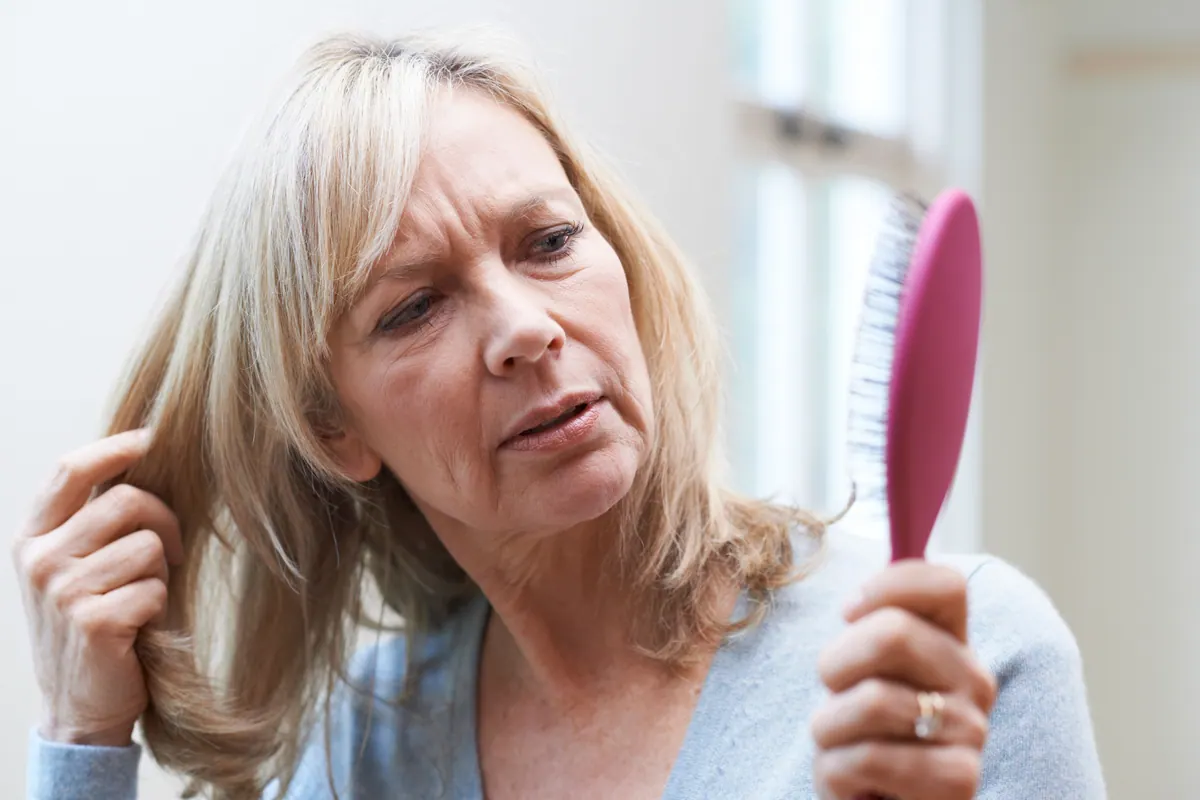
Will HRT help thinning hair?
Probably not enough to count on, and it is not recommended or started for that reason. The Menopause Society’s 2022 position statement says that changes in hair density and female pattern hair loss worsen after menopause, but that research is lacking on whether hormone therapy mitigates them.
A 2026 review for hair specialists in the journal Dermatology reached the same practical conclusion: HRT is not currently indicated for hair loss alone in menopausal women. It is used to treat hot flashes and night sweats and, in suitable women, to protect bone, and its risks and benefits are weighed for those purposes.
What happens to hair around menopause?
Hair tends to spend less time growing after menopause, and two specific hair conditions become more common. A review of hair disorders in menopause in Clinical and Experimental Dermatology describes a reduction in actively growing (anagen) hairs in postmenopausal women and links both female pattern hair loss and frontal fibrosing alopecia to the perimenopausal and postmenopausal years.
Androgens, estrogen and progesterone all play a part in the hair cycle, according to the same review, which is why the shift at menopause shows up on the scalp as a wider part and less volume on the crown. The reviewers also found insufficient evidence that HRT treats pattern hair loss, and they stress that the role of hormonal therapy still needs research.
Frontal fibrosing alopecia is different. The review describes it as a scarring condition, a variant of lichen planopilaris, causing progressive loss along the front and temple hairline, often with eyebrow involvement. Because scarred follicles do not regrow, a receding hairline in midlife should be seen by a dermatologist promptly rather than treated as ordinary thinning.
If you already take HRT, will it change your hair?
For most women, no. The 2026 Dermatology review found that women who are good candidates and have a reason to take HRT can continue skin-applied estrogen and oral medroxyprogesterone without added concern about hair loss.
The same review said skin-applied testosterone is acceptable under close gynecological monitoring and usually does not harm the hair. That matches the Global Consensus Position Statement on testosterone for women, which reported mild increases in acne and body or facial hair in some women in trials, but not scalp hair loss, at doses aimed at premenopausal levels. The consensus also notes that no testosterone product is approved for women by a national regulator, so any use is off-label and carefully dosed.
If you are deciding whether HRT makes sense for your symptoms, the hormone therapy page explains how we assess it; hair is not one of the reasons on that list.
What should be checked before treating menopausal thinning?
Before anyone puts thinning down to menopause alone, a short workup looks for the causes that have their own fixes. In midlife the usual suspects are thyroid disease, low iron stores, vitamin D deficiency and, less often, a hormone-producing condition.
The specialist guidance on this comes from the Androgen Excess and PCOS Society, whose task force said a check for androgen excess is mandatory in any woman with pattern thinning, and that measuring thyroid function, iron, vitamin D, zinc and prolactin is worthwhile though optional. For a woman past menopause, the visit usually covers:
- Your timeline: gradual thinning over years, or a sudden shed after an illness, operation, weight loss or bereavement
- A scalp and hairline exam, including the eyebrows
- Ferritin, TSH, vitamin D and, where the history points that way, testosterone, SHBG and prolactin
- A look for the physical signs of androgen excess that MedlinePlus describes, such as coarse new facial hair, acne or clitoral enlargement
That timeline question matters because shedding behaves differently. The AAD’s guide to shedding explains that excess shedding usually starts a few months after a trigger and that hair tends to regain its fullness within six to nine months once the body readjusts, so a recent surge of loose hairs is not the same problem as years of slow thinning. If your symptoms are hard to untangle, our symptom assessment helps you list them before a visit.
Which treatments have evidence?
The option with the strongest support is not hormonal at all: it is minoxidil applied to the scalp, the one medicine FDA has approved for female pattern hair loss, as MedlinePlus notes, and the first-line choice in the AE-PCOS recommendations. It needs months of steady use and works only while you keep using it.
Beyond that, choices include low-dose oral minoxidil (off-label), platelet-rich plasma injections (off-label, with early evidence) and treating whatever the blood tests turn up. The details are on our pages about female pattern hair loss and the evidence on PRP for thinning hair in women. Skin often changes in the same years; menopause skin changes covers that side.
Whose answer is different?
The answer changes for three groups. Women with an early or surgical menopause often have separate reasons to consider hormone therapy, which their clinician weighs on its own terms; hair is still not one of them.
Women with signs of androgen excess, such as new facial hair, acne or a rapidly widening part, need hormone testing before any hair treatment, because the cause may be treatable in its own right. And women whose hairline is receding or whose eyebrows are thinning need a dermatologist to rule out a scarring condition, where a prompt diagnosis matters.
How we approach hair thinning in midlife
For a midlife woman, our hair visit pairs blood work for iron, thyroid and hormones with a scalp exam and baseline photos. The provider then explains what the results mean and builds a plan that may include topical or oral minoxidil, PRP scalp injections, correction of deficiencies and hormonal options where appropriate, which for hair means checking that any HRT you take is not working against you rather than starting it for hair.
You will not be told that hormones will thicken your hair, because the evidence does not say so. The hair restoration page has more detail, and other short explainers are in our answers library. Ask on the free ten-minute call what a first visit would include, and book a consultation when it suits you.
