Answer · Hair restoration
Thyroid Hair Loss: Does It Grow Back After Treatment?
Short answer
Often, yes. The American Academy of Dermatology says treating thyroid disease can reverse the hair loss it causes. Regrowth trails the lab results by months because hair grows slowly, and a brief shed can happen in the first months of levothyroxine. Thinning that continues on normal levels is a reason to check for a second cause, such as low iron or female pattern hair loss.
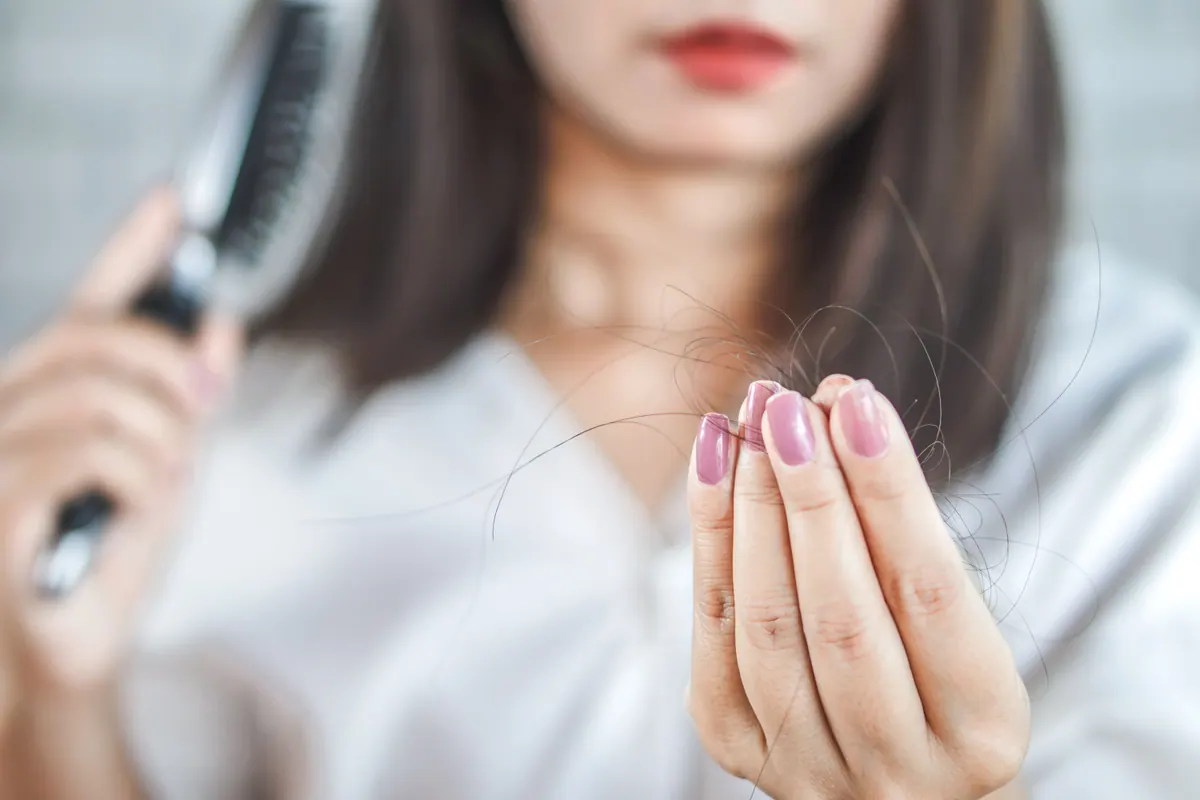
Does hair lost to a thyroid problem grow back?
It can, once the thyroid itself is treated. The American Academy of Dermatology’s guide to the causes of hair loss lists thyroid disease as a cause of thinning hair, notes that some people find it coming out in clumps when they brush, and answers the regrowth question directly: treating the thyroid disease can reverse the hair loss.
That holds for both directions. An underactive thyroid and an overactive one can each thin the hair, and correcting either one removes the trigger. What treatment cannot do is speed up the hair cycle, which is why the mirror lags behind the lab report.
What does thyroid-related thinning look like?
The AAD’s checklist of thyroid-related skin, hair and nail changes gives a useful picture of what to look for:
- Thinning or missing hair at the outer edge of the eyebrows
- Coarse, dull, dry and brittle hair that breaks easily
- Soft, fine hair with a lot of shedding
- Thinning across the scalp or balding patches
- Hair that grows more slowly, or faster, than it used to
- A dry, itchy scalp with dandruff
- Less hair on the arms and legs
The same page is careful to say these signs do not necessarily mean thyroid disease, and that a blood test is how a doctor decides. Photos of your part and hairline taken a few months apart show change more fairly than daily checks in the mirror.
Why might hair shed after you start levothyroxine?
A brief shed early in treatment is listed as rare and usually temporary. The Synthroid label describes partial hair loss in the opening months of therapy as a rare event that usually passes.
It is unsettling to lose more hair on the medicine meant to fix it. If it happens, talk it through with whoever looks after your thyroid treatment before altering anything about the tablet, and give the dose time to settle before deciding it is not working.
Why does your hair lag behind your lab results?
Hair runs on a slow cycle, and fixing the thyroid restarts growth rather than producing instant length. The AAD’s page on hair shedding versus hair loss says shedding 50 to 100 hairs a day is normal, and that heavier shedding after a stressor is usually noticed a few months after the event.
The AAD gives that timescale for stressors such as giving birth, a high fever, surgery or losing 20 pounds or more, not for thyroid disease specifically. Still, it is the honest benchmark: hair tends to regain its normal fullness within six to nine months of the trigger ending, and shedding continues if the trigger stays. A thyroid that has been back in range for six weeks has not yet had time to show in your ponytail. If topical minoxidil is added, it runs on its own clock: the AAD says about six to 12 months of continuous use before you know how well it works.
What else can thin your hair at the same time?
Thyroid disease often has company, and a second cause can keep hair thin after the thyroid is fixed:
- Low iron or protein. The AAD lists too little biotin, iron, protein or zinc as a cause of noticeable hair loss, with regrowth once the body has enough. That is not a case for biotin pills: MedlinePlus says there is no good scientific evidence for biotin as a hair loss treatment and warns that it can distort blood tests.
- Alopecia areata. This autoimmune condition attacks hair follicles, and the AAD’s page on alopecia areata causes names thyroid disease among the autoimmune conditions linked to it. The AAD describes the loss as patchy, and it can affect the eyebrows and lashes as well as the scalp.
- Female pattern hair loss. The AAD’s page on female pattern hair loss describes a part that gets wider, notes that it is hereditary and more common after menopause, and lists 2% or 5% topical minoxidil as the FDA-approved over-the-counter treatment for women. Our page on female pattern hair loss covers the full workup.
- Shedding after a birth. It peaks about four months after delivery, per the AAD; see postpartum hair loss, since postpartum thyroid changes can overlap with it.
- Rapid weight loss. Losing 20 pounds or more is on the AAD’s list of shedding triggers, which matters if you are also on a GLP-1 medicine; our page on whether semaglutide causes hair loss covers that case.
Who should look beyond the thyroid?
- Thinning that continues well past six to nine months on stable, normal levels. That timing points to a second cause.
- Patchy loss on the scalp, eyebrows or lashes. That pattern is more typical of alopecia areata and deserves a dermatology review.
- A widening part or thinning crown with a family history. That fits female pattern hair loss, which needs its own treatment.
- Shedding that began two or three months after a fever, an operation or a crash diet. Those are AAD-listed triggers in their own right, and the thyroid may be a bystander.
- Pregnancy, planning a pregnancy or breastfeeding. The AAD advises avoiding minoxidil in all three situations.
If you cannot tell which of these fits you, our short health assessment helps you sort the possibilities before a visit.
How our hair program checks the thyroid first
Our hair restoration visits start with labs for iron, thyroid and hormones, because correcting a thyroid or iron gap can matter more than any scalp treatment. If you are already on levothyroxine, we look at whether your levels are stable and how long they have been in range before judging the hair.
Treatment options, chosen after that evaluation, include correcting iron, vitamin D or thyroid gaps, topical minoxidil, and oral minoxidil, which is an off-label use for hair loss. We also offer platelet-rich plasma (PRP) scalp injections, usually three sessions a month apart, as an off-label treatment that is not FDA-approved for hair loss; the AAD describes PRP as early-stage research with promising but limited findings. You can read about our hair restoration for women, browse more answers on women’s health, or arrange the free ten-minute call by phone and then book a consultation.
