Patient guide · Menopause care
Strength Training After Menopause: A Starter Plan
Short answer
After menopause, strength training slows the loss of muscle, supports bone and balance, and helps your body handle blood sugar. Federal guidelines call for muscle-strengthening work at least two days a week covering all major muscle groups, plus 150 minutes of moderate aerobic activity. Start with body weight or light resistance, build to sets of 8 to 12 repetitions, and adjust if you have osteoporosis or bladder leaks.
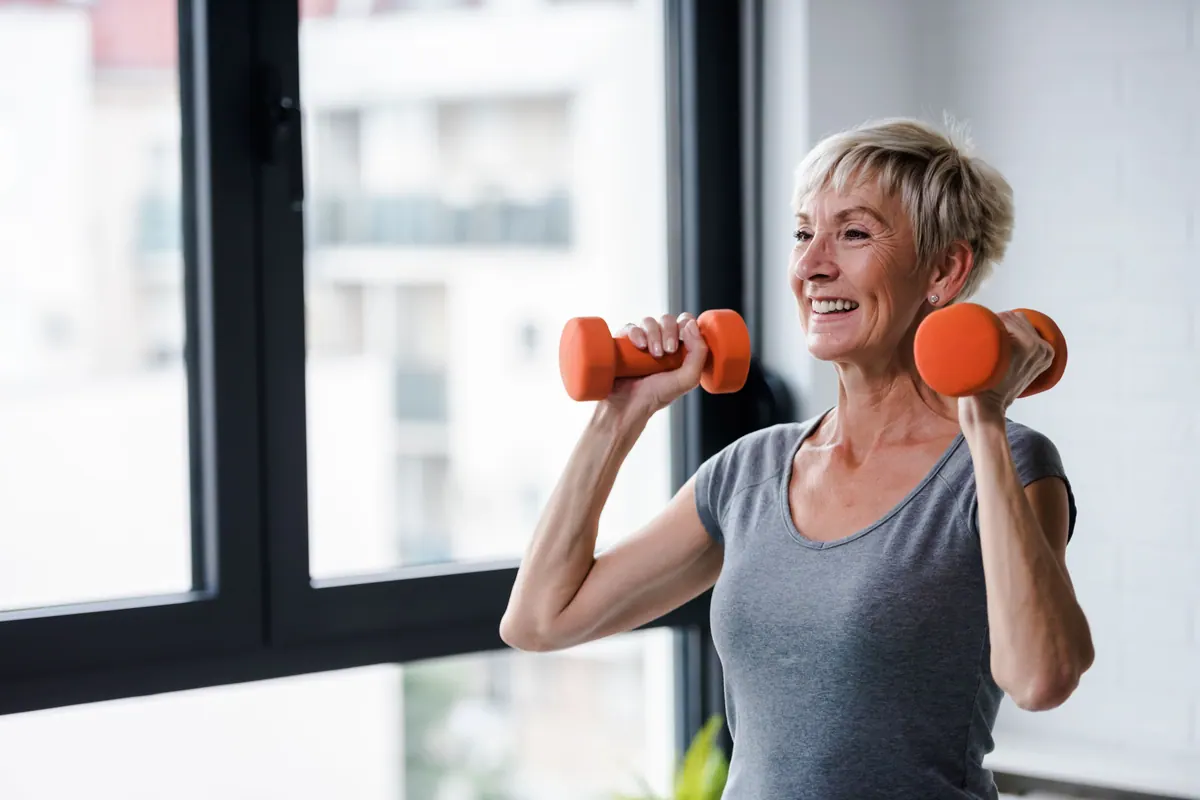
Who is this plan for?
This guide is for women past menopause, or close to it, who are new to strength training or returning after years away. It assumes you can walk comfortably and get up from a chair without help. It is a starting structure rather than a personal exercise program, and it includes the changes to make if you have osteoporosis, joint problems or pelvic floor symptoms.
If you have heart disease, uncontrolled high blood pressure, a recent fracture, recent surgery or chest symptoms with exertion, get your clinician’s go-ahead before you start. After any operation, including a hysterectomy, ask your surgeon when lifting is safe again; the hormone side of that surgery is covered on our page about menopause after a hysterectomy.
Why strength training matters more after menopause
Four reasons, each with evidence behind it:
- Muscle. The National Institute on Aging (NIA) says muscle-strengthening work is key to keeping existing strength, slowing the loss of muscle mass and making everyday tasks easier, from climbing stairs to carrying groceries.
- Bone. Bone responds to load. The Bone Health and Osteoporosis Foundation names weight-bearing and muscle-strengthening exercise as the two types that build and maintain bone density. Our page on bone loss after menopause explains why the years around the final period matter so much.
- Blood sugar. NIDDK lists not being physically active among the risk factors for insulin resistance and prediabetes, and being active among the ways to lower that risk.
- Falls. NIA notes that strength and balance work both help prevent falls and fall-related injuries, which is where weak bones turn into fractures.
What do the guidelines ask for each week?
Two kinds of activity, every week. The CDC’s adult activity guidelines set the floor:
| Type | Weekly target | Examples |
|---|---|---|
| Moderate aerobic activity | 150 minutes (or 75 minutes vigorous) | Brisk walking, cycling, swimming, dancing |
| Muscle-strengthening | 2 or more days, all major muscle groups | Weights, bands, body-weight exercises, heavy gardening |
| Balance (NIA advice for older adults) | About 3 sessions | Standing on one foot, heel-to-toe walk, tai chi |
The major muscle groups are the legs, hips, back, abdomen, chest, shoulders and arms. NIA adds two details that shape a plan: avoid working the same muscle group on two days in a row, and work to the point where one more repetition would be hard.
A 12-week starter plan
Do the strength session on two non-consecutive days, such as Monday and Thursday. Each session takes 30 to 40 minutes, including a 5-minute warm-up of easy walking or marching in place.
The six movements
- Sit-to-stand from a chair (legs, hips)
- Wall or counter push-up (chest, shoulders, arms)
- Band row with the band looped around a sturdy post (upper back, arms)
- Step-up onto a low step, holding a rail (legs, balance)
- Hip bridge lying on your back (hips, lower back)
- Farmer’s carry: walk holding a weight in each hand (grip, core, posture)
These match the kinds of exercises NIA lists: body-weight moves such as squats, push-ups and planks, resistance bands, hand-held weights and carrying heavy items.
How to progress
| Weeks | Sets and repetitions | Load |
|---|---|---|
| 1 to 2 | 1 set of 8 to 10 | Body weight only; learn the movement |
| 3 to 4 | 1 set of 10 to 12 | Add a light band or light hand weights |
| 5 to 8 | 2 sets of 8 to 12 | Increase the band or weight when 12 feels easy |
| 9 to 12 | 2 to 3 sets of 8 to 12 | Keep raising the load gradually; consider adding a third day |
NIA notes that one set of 8 to 12 repetitions of each exercise is effective, although two or three sets may be more effective, and that strength grows with gradual increases in weight, sets, repetitions or days. After 12 weeks, you can move on to gym machines or free weights, ideally with a trainer’s help at first.
Balance on the other days
Add 5 to 10 minutes of balance work three times a week: stand on one foot near a counter, walk heel to toe, or try a tai chi class. Fold it into your walks if that is easier to keep up.
Adjustments for osteoporosis, joints and leaks
If you have osteoporosis or low bone mass
Body position matters most. NIA’s osteoporosis guidance advises avoiding movements that twist the spine, like a golf swing, or bend forward from the waist, like sit-ups and toe touches. BHOF adds that if you have broken a bone from osteoporosis or are at risk of one, you may need to avoid high-impact exercise such as jumping or running, and suggests working with a provider or exercise specialist on safe positions.
Heavy lifting is not automatically off limits. In the LIFTMOR randomized trial, 101 postmenopausal women with low bone mass did 30-minute supervised sessions twice a week for 8 months, using 5 sets of 5 repetitions at more than 85% of their maximum. Spine density rose 2.9% on average, against a 1.2% loss in a gentle home program, with one minor back spasm reported. Every session was closely supervised, which is the condition for trying anything similar.
If you leak or feel pelvic pressure
Leaks during lifting are common and treatable. NIDDK reports that women who had pelvic floor muscle training had fewer leaks per day than women who did not, and that a physical therapist trained in pelvic floor therapy can help you combine it with core strength. In the meantime, lower the load, breathe out as you lift, and skip any exercise that causes leaking, heaviness or a bulging sensation until it has been checked.
If your joints complain
Swap step-ups for sit-to-stands, use a shorter range of motion, and move to machines or water exercise if impact hurts. Muscle soreness for a day or two after a new exercise is expected; sharp joint pain is a reason to stop that movement.
What to watch for, and when to get help
Use this checklist after each session:
- Mild muscle soreness for 24 to 48 hours: normal while you adapt
- Joint pain that lingers or swelling: drop the load and tell your clinician if it persists
- New leaking, pressure or bulging in the vagina: stop that exercise and book a pelvic floor assessment
- New back pain after a lift, especially with known osteoporosis: stop and get checked promptly
- Dizziness, unusual breathlessness or nausea: NIA says activity should not cause these, so stop and rest
Call 911 for chest pain or pressure, severe shortness of breath, fainting, or sudden weakness or numbness on one side of the body during or after exercise. Do not try to finish the set.
How our clinic supports an exercise plan
At our clinic, strength training is part of menopause care rather than an afterthought. A provider reviews your symptoms, bone and heart risks and any pelvic floor concerns, orders labs such as vitamin D, thyroid and iron at San Gabriel or Downey, and arranges a bone density scan by referral when it is due. Calcium and vitamin D intake often comes up at the same visit, and our page on calcium and vitamin D after menopause covers the amounts.
Our menopause care program includes strength and nutrition guidance alongside hormone and non-hormonal treatment, and sleep support, because poor sleep makes any exercise plan harder to keep. If leaks are holding you back, pelvic floor treatment and referral to pelvic floor physical therapy are available.
Unsure where to start? Our symptom assessment can point you to the right first conversation. When you are ready, book a consultation. More step-by-step guides are in our guides library.
