Answer · Menopause care
When Should Women Get a Bone Density Scan (DEXA)?
Short answer
The US Preventive Services Task Force recommends a DEXA bone density scan for every woman 65 or older. Postmenopausal women under 65 should have one if a clinical risk tool shows raised fracture risk, for example because of early menopause, low body weight, smoking, steroid use or a parent's hip fracture. The scan is quick and painless, and how often to repeat it depends on the first result.
What does the USPSTF recommend for women?
Two groups of women should be screened, according to the US Preventive Services Task Force’s January 2025 recommendation, which carries a grade B:
- All women 65 and older. No risk factors are needed.
- Postmenopausal women younger than 65 at increased risk. The task force suggests first checking for one or more risk factors, then using a clinical risk assessment tool to estimate risk and decide whether a scan is warranted.
The 2025 update spells out that screening means a DXA (dual-energy X-ray absorptiometry, often written DEXA) measurement of bone mineral density, with or without a fracture risk calculation. It is otherwise in line with the task force’s 2018 advice.
Why 65 and not 50? Osteoporosis has no symptoms until a bone breaks, as the National Institute on Aging puts it, and the risk of developing it increases as you get older. The task force’s own example shows how risk climbs: a 65-year-old White woman with an average body mass index and no other risk factors has a 10-year chance of 1.3% for a hip fracture and 9.3% for any major osteoporotic fracture.
Which risk factors bring the scan forward?
Factors that can justify a scan before 65 appear in both the USPSTF text and MedlinePlus’s guide to the bone density test:
| Group | Examples |
|---|---|
| Menopause timing | Early menopause, natural or surgical |
| Body size | Low body weight; MedlinePlus cites under 127 pounds or a body mass index under 20 |
| Family and personal history | A parent with a hip fracture, a strong family history of osteoporosis, your own fracture after 50, significant height loss |
| Habits | Smoking, heavy drinking |
| Medicines | Long-term corticosteroids, thyroid hormone, aromatase inhibitors for breast cancer |
| Conditions | Rheumatoid arthritis, diabetes treated with insulin, thyroid disease, past anorexia nervosa |
A single factor does not automatically mean a scan. The USPSTF approach is to feed those factors into a tool such as FRAX, the Osteoporosis Self-Assessment Tool (OST) or the Osteoporosis Risk Assessment Instrument (ORAI). The tools for identifying osteoporosis have commonly used cutoffs, while FRAX has no defined screening threshold, so the result informs the decision rather than making it.
What actually happens during a DEXA scan?
It is one of the easier tests in medicine. MedlinePlus describes it this way:
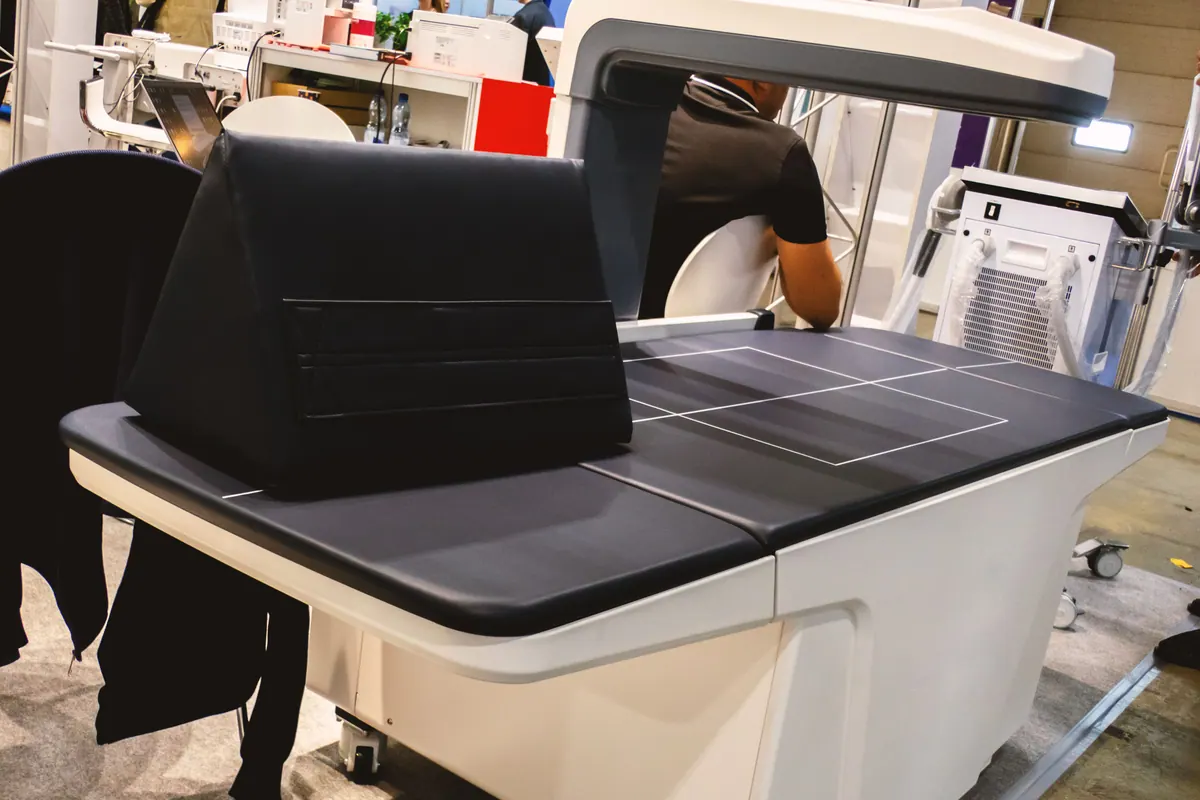
- You lie on a padded table while a scanner arm passes over your lower spine and hip. Most people stay dressed.
- The X-ray dose is low; you receive more radiation from a chest X-ray.
- The scan is painless, and you need only lie still.
- Skip calcium supplements for 24 hours beforehand, and remove metal such as belt buckles and jewelry.
- Tell the technician if you are or could be pregnant.
MedlinePlus describes the central scan of the hip and spine as the test that predicts fracture risk most accurately, especially for the hip. The small peripheral machines sometimes found at pharmacies and health fairs measure the wrist, finger, leg or heel instead, so a heel reading from a health fair does not replace it.
How is a DEXA result read?
The report gives a T-score that compares your bones with a healthy young adult’s. The Bone Health and Osteoporosis Foundation classifies -1.0 or above as normal, between -1.0 and -2.5 as low bone mass, and -2.5 or below as osteoporosis in postmenopausal women.
Two caveats matter. First, BHOF notes that a fracture of the spine, hip, wrist, shoulder, rib or pelvis after 50 can point to osteoporosis even with a better score. Second, the number is a starting point for a risk conversation, not a full answer. What a low score means for you, and which prevention steps fit, is the subject of our page on bone loss after menopause.
How often should you repeat the scan?
There is no single interval for everyone, and the right gap depends on your first result. The USPSTF reports that, in cohort studies, repeating the test every 4 to 8 years did not add accuracy in predicting fractures.
The time it takes to slide into osteoporosis varies widely, and the task force cites one study to show it:
| Starting point | Time for 10% of women to develop osteoporosis |
|---|---|
| Normal bone density | Almost 17 years |
| T-score between -1.50 and -1.99 | About 5 years |
Lower scores and older age shorten the gap. For women on an osteoporosis medicine, MedlinePlus says the scan is usually repeated every 2 years or longer to see whether it is working. Medicare covers a bone mass measurement once every 24 months for eligible women, or more often when medically necessary.
Who does the timing differ for?
Four groups often need a scan sooner than 65 or on a closer schedule:
- Women with menopause before 45. Early menopause is on the MedlinePlus risk list, so it is reasonable to ask about a scan at diagnosis rather than waiting for 65.
- Women losing weight on medication. Weight loss can affect bone density, and our page on GLP-1 medicines and bone density explains what trials show and how to plan for it.
- Women on long-term steroids or aromatase inhibitors. Both are on the MedlinePlus risk list, and Medicare also covers scans for women starting steroid-type drugs.
- Anyone who has broken a bone in a minor fall after 50. That fracture itself is a warning sign worth testing.
Women weighing hormone therapy sometimes ask whether to scan first. A result can help, especially when bone protection is one of the reasons, and our page on whether HRT prevents osteoporosis explains how that fits.
How our clinic handles bone density screening
At our clinic, a provider looks at your age, menopause timing, medicines, weight history and family history to judge whether a scan is due now or later. We then order the DEXA or refer you to an imaging center for it, and review the result with you alongside labs such as vitamin D, thyroid and kidney function drawn at San Gabriel or Downey.
Bone screening on a schedule is part of our menopause care program, along with hormone therapy where it suits you and guidance on strength, protein and calcium. Bone-building medicines for established osteoporosis are managed with a specialist.
If you are unsure which risk factors apply to you, try our quick symptom and risk assessment. You can also book a consultation or read more in our answers library.
