Condition · Menopause care
Menopause Joint Pain: Why Joints Ache and What Helps
Short answer
Joint aches and morning stiffness often appear or worsen around menopause, and estrogen acts on joint tissue, though its exact role is still debated. In the Women's Health Initiative, estrogen alone produced a modest, lasting drop in how often women reported joint pain. Osteoarthritis, rheumatoid arthritis and an underactive thyroid can feel similar, so persistent pain deserves an exam and, sometimes, blood tests.
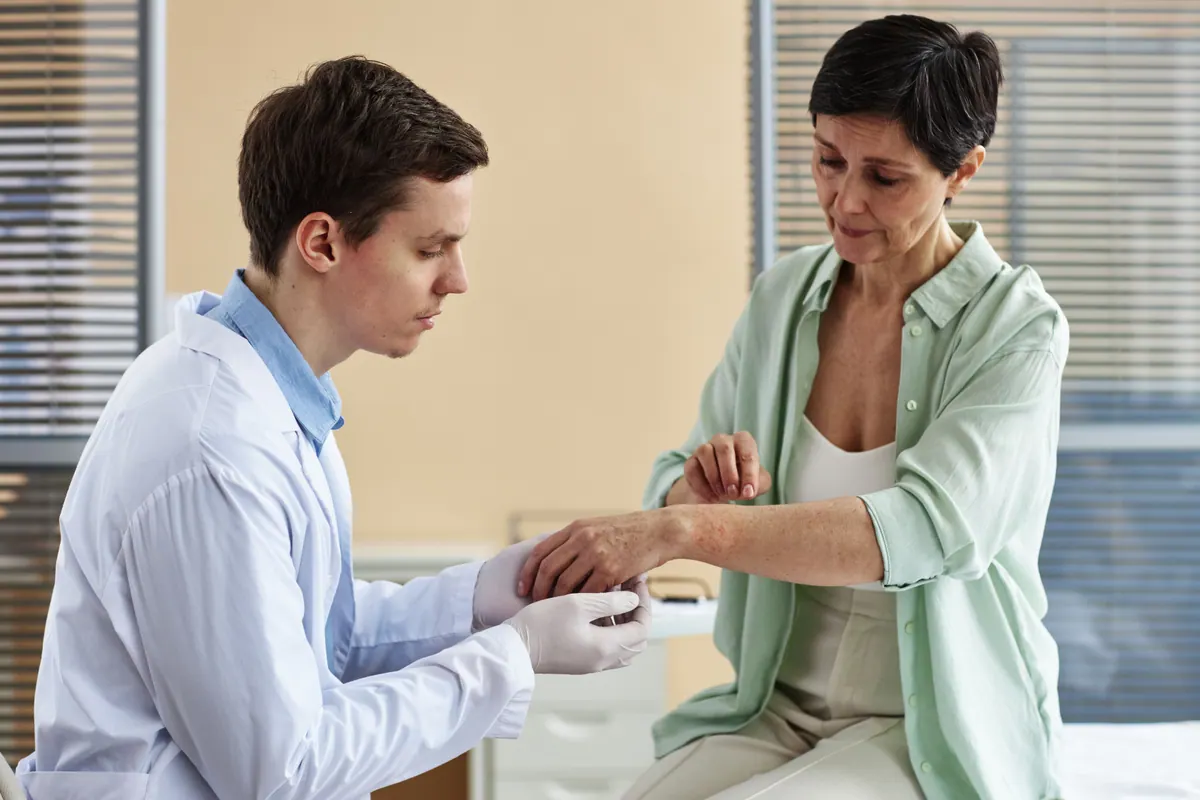
What menopause joint aches tend to feel like
The usual description is stiffness on getting out of bed or out of a chair, fingers that feel thick in the morning, knees that complain on the stairs, and a general ache that was not there a few years ago. It often arrives in the same years as hot flashes and broken sleep, which is why many women connect it to menopause.
The connection is plausible but not fully settled. Joint symptoms are common after menopause, and before treatment in one large trial about 77% of women already reported joint pain and about 40% joint swelling. That baseline shows how ordinary these complaints are in postmenopausal women, and how hard it is to separate hormones from age.
What is known about estrogen and joints
Estrogen does act on joints. The Menopause Society’s 2022 position statement explains that estrogen binds to receptors in joint tissues and helps protect their structure and function, but that its exact effect on osteoarthritis remains controversial. There is no clearly observed link between hormone therapy and osteoarthritis, and meta-analyses of estrogen trials have given inconsistent results.
In other words, falling estrogen may contribute to aches, but it does not appear to cause or prevent arthritis in any reliable way. The statement’s summary is that women in the Women’s Health Initiative (WHI) and other studies had less joint pain or stiffness on hormone therapy than on placebo, and that estrogen’s role in joint health still needs more study.
What the WHI trials found
The clearest data come from the WHI estrogen-alone trial. In a post hoc analysis of 10,739 women who had had a hysterectomy, randomized to oral conjugated equine estrogens 0.625 mg a day or placebo, joint pain after 1 year was reported by 76.3% of the estrogen group and 79.2% of the placebo group. Pain severity was lower too, and the difference lasted through year 3.
Two caveats keep this in proportion. The difference was small, about 3 percentage points, and joint swelling was slightly more common with estrogen (42.1% versus 39.7%), although that gap weakened when the researchers accounted for adherence. The authors described a modest but sustained reduction in joint pain frequency.
The combined estrogen and progestin arm told a similar story. The 2022 statement reports that women on combined therapy had less joint pain or stiffness than those on placebo, and more joint discomfort after stopping. These findings come from oral conjugated estrogens given to women whose average age was 63, so they cannot be applied neatly to a 50-year-old on a modern patch.
Osteoarthritis, rheumatoid arthritis or menopause?
The pattern of stiffness is the most useful clue. MedlinePlus notes that osteoarthritis stiffness usually lasts 30 minutes or less after waking, and the National Institute of Arthritis and Musculoskeletal and Skin Diseases describes rheumatoid arthritis stiffness that lasts longer than 30 minutes.
| Feature | Osteoarthritis | Rheumatoid arthritis |
|---|---|---|
| Morning stiffness | Usually 30 minutes or less | Longer than 30 minutes |
| Pattern | Starts in one or a few joints, often hands, knees, hips or neck | Often mirrored on both sides, most often wrists, hands and feet |
| Swelling | Bony enlargement, sometimes fluid in the joint | Swelling and tenderness in the affected joints |
| Blood tests | Not useful for diagnosis | Rheumatoid factor, anti-CCP, ESR and CRP support it |
| Who | More common in women, especially after 50 | Two to three times more common in women than men |
NIAMS also notes that osteoarthritis is more common in women than men, especially after 50, and that for many women it develops after menopause. Overlap is common: a woman can have early osteoarthritis and transition-related aches at the same time.
Other causes worth ruling out
An underactive thyroid is the main look-alike. MedlinePlus lists joint or muscle pain among the symptoms of hypothyroidism, along with fatigue, feeling cold, heavier or irregular periods and weight gain, all of which overlap with the transition. A TSH test is a simple way to check.
Rheumatoid arthritis needs blood work and an exam. MedlinePlus’s rheumatoid arthritis page lists positive rheumatoid factor or anti-CCP antibodies and an elevated ESR or CRP among the findings that support the diagnosis, and notes the anti-CCP test is more specific for RA. For osteoarthritis, the same encyclopedia explains that blood tests are not helpful for diagnosis but can rule out rheumatoid arthritis or gout.
What helps aching joints
Movement and strength help most, and they are within your control. MedlinePlus advises staying active and exercising to maintain joint movement, keeping the muscles around weight-bearing joints strong, losing weight if you are overweight, and physical therapy, noting that if therapy has not helped after 6 to 12 weeks it likely will not. Being overweight raises the risk of osteoarthritis in the hip, knee, ankle and foot.
Sleep matters too, because pain and broken sleep amplify each other; our page on menopause insomnia and its drivers explains the separate causes of night waking. Aches, poor sleep and slower thinking often arrive together, and our page on menopause brain fog covers that last piece.
Hormone therapy has a supporting role at most. If you are considering it for hot flashes or sleep, a modest easing of joint pain is a possible extra, but the WHI data do not justify starting it for joints alone.
| Approach | What the evidence shows | At our clinic |
|---|---|---|
| Strength training and staying active | Recommended for osteoarthritis symptoms | Strength and nutrition guidance offered |
| Weight loss when overweight | Lowers load on hips, knees and ankles | Guidance offered |
| Hormone therapy | Small reduction in joint pain in WHI trials | Offered when indicated for other symptoms |
| Thyroid treatment | Treats aches caused by hypothyroidism | Thyroid testing and care offered |
| Rheumatology care | Needed for inflammatory arthritis | By referral |
How we assess joint pain at our clinic
We start by asking whether your aches behave like the transition or like arthritis. On the free ten-minute call, describe which joints hurt, how long morning stiffness lasts, and whether anything is swollen or warm. At a consultation in San Gabriel or Downey, your provider examines the joints and may order a TSH, inflammatory markers and other labs; follow-up conversations can happen by video.
If the picture fits menopause, your plan may combine strength and nutrition guidance with treatment of the symptoms that brought you in, described on our menopause care page. Signs of inflammatory arthritis lead to a rheumatology referral. If you are unsure whether your aches are hormonal at all, the symptom assessment helps you sort the pieces, and the conditions library has pages on the sleep and mood problems that often come with it. To have it checked, book a consultation.
