Medication guide · Medical weight loss
Orforglipron (Foundayo): The Daily GLP-1 Pill Explained
Short answer
Orforglipron, sold as Foundayo, is a once-daily GLP-1 tablet the FDA approved on 1 April 2026 for weight management in adults. Unlike oral semaglutide, it can be taken with or without food. In its main trial, adults on the highest dose lost an average of 11.1% of body weight over 72 weeks, versus 2.1% on placebo. It carries a thyroid tumor boxed warning.
What is orforglipron, and when was it approved?
Orforglipron is a small-molecule GLP-1 receptor agonist: a conventional pill-sized chemical rather than a peptide like semaglutide or tirzepatide. The FDA approved it as Foundayo on 1 April 2026, 50 days after the application was filed, under the agency’s National Priority Voucher pilot. It was the first new molecular entity approved through that program.
It is approved, with a reduced-calorie diet and more physical activity, to reduce excess weight and keep it off in adults with obesity, or with overweight plus at least one weight-related condition. That is its only approved use for now; it has no heart, sleep apnea or diabetes approval. The FDA’s announcement describes it as a GLP-1 receptor partial agonist that does not need to be taken on an empty stomach.
How do you take Foundayo?
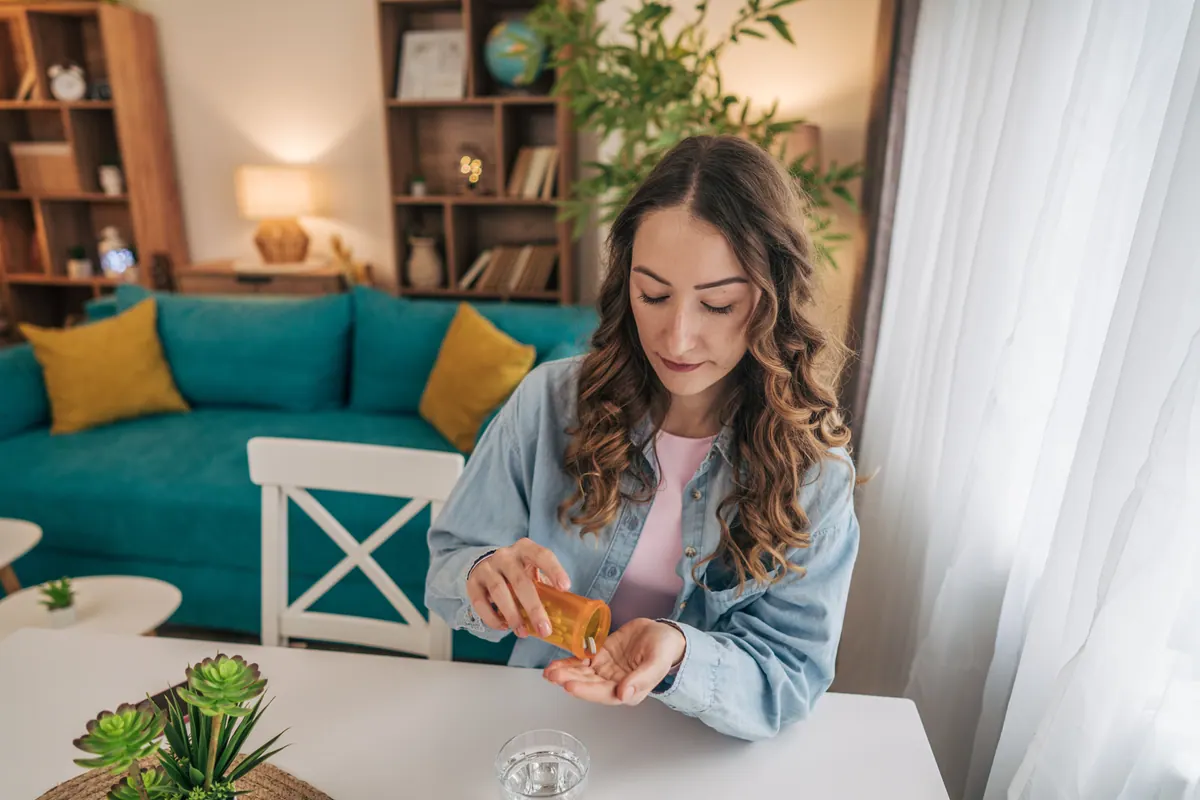
Take one tablet a day, with or without food, swallowed whole. There is no water limit and no waiting period before breakfast, which is the main practical difference from the Wegovy tablet, covered on our Wegovy pill page.
The Foundayo label climbs in steps of at least 30 days. Your clinician decides whether to go past 5.5 mg, based on response and side effects.
| Step | Daily dose | Minimum time at the step |
|---|---|---|
| Start | 0.8 mg | 30 days |
| Second | 2.5 mg | 30 days |
| Third | 5.5 mg | 30 days, or stay if it works |
| Optional | 9 mg, then 14.5 mg | 30 days each |
| Highest | 17.2 mg | Ongoing |
If you miss a tablet, take it as soon as you remember, but never two in one day. After 7 or more missed days in a row, the label says to restart the climb at a lower dose to limit stomach side effects.
What did the ATTAIN trials find?
Two 72-week, placebo-controlled trials support the approval. The first enrolled 3,127 adults without diabetes; 64% were women and the average age was 45. The label reports average weight change of -7.4% on 5.5 mg, -8.3% on 9 mg and -11.1% on 17.2 mg, against -2.1% on placebo. In the second trial, of 1,613 adults with type 2 diabetes, the 17.2 mg dose averaged -9.6% versus -2.5%.
The published report of the first trial, ATTAIN-1 in the New England Journal of Medicine, used an earlier formulation at 6, 12 and 36 mg; the label converts those to the equivalent Foundayo doses. At the highest dose, 54.6% of participants lost at least 10% of their weight and 36.0% lost at least 15%, compared with 12.9% and 5.9% on placebo. Side effects led 5.3% to 10.3% of people on orforglipron to stop, versus 2.7% on placebo.
Side effects and the boxed warning
Stomach effects dominate, and they rise with dose. In the pooled trials at 17.2 mg, nausea affected 35% (10% on placebo), diarrhea 25%, vomiting 24% and constipation 24%. They were most frequent during the dose climb. Other reported effects include indigestion, headache, bloating, fatigue, burping, reflux and gas. Heart rate rose by an average of 4 to 5 beats per minute.
Hair loss followed the same pattern seen with injectable GLP-1 medicines: it was linked to weight loss and reported in 7% of women versus 0.9% of men on Foundayo.
The boxed warning is worded differently from other GLP-1 labels. Orforglipron is not active in rats or mice and did not cause tumors in rodents, but because other drugs acting on the GLP-1 receptor cause thyroid C-cell tumors in rodents and human relevance is unknown, it is contraindicated with a personal or family history of medullary thyroid carcinoma or with MEN 2. Other warnings cover pancreatitis, severe stomach and bowel reactions, kidney injury from dehydration, low blood sugar with insulin or a sulfonylurea, allergic reactions, diabetic eye disease, gallbladder disease and aspiration during anesthesia.
Drug interactions, including birth control pills
Orforglipron is broken down mainly through the CYP3A4 pathway, which adds interactions that the injectable GLP-1 labels do not list. Its half-life is about 29 to 49 hours, short enough that it is taken daily:
- Strong CYP3A4 inhibitors raise orforglipron levels; the dose is capped at 9 mg with them, and those that also block OATP1B, such as ritonavir, are to be avoided.
- Strong CYP3A4 inducers lower its levels and are to be avoided; with moderate inducers, effectiveness is monitored.
- Simvastatin should not exceed 20 mg a day alongside Foundayo.
- Birth control pills. The effect on oral contraceptives has not been tested, so the label advises switching to a non-oral method, or adding a barrier method, for 30 days after starting and for 30 days after each dose increase. Non-oral hormonal methods should not be affected. The rule mirrors tirzepatide’s, explained on our page about tirzepatide and birth control, but runs 30 days rather than 4 weeks.
Bring a full list of your medicines, supplements included, to any visit where this pill is discussed.
Who should not take orforglipron, and what gets monitored
Foundayo is contraindicated with a personal or family history of medullary thyroid carcinoma, with MEN 2, and after a serious allergic reaction to it. The label advises stopping it when pregnancy is recognized, recommends effective contraception while taking it, says it is not recommended for nursing women, and advises against it with severe liver impairment (Child-Pugh C). No dose change is needed for kidney impairment. It should not be combined with another GLP-1 medicine.
Monitoring usually includes weight, tolerance and hydration, heart rate, blood sugar for anyone on diabetes medicines, and a check of any interacting drugs. Protein intake deserves attention whichever GLP-1 you use; our guide to protein on a GLP-1 has daily targets.
Is orforglipron offered at our clinic?
Orforglipron is not on our clinic’s treatment menu. Our medical weight loss program lists semaglutide or tirzepatide as weekly injections. If you are interested in a daily pill, ask your clinician whether it fits you; a provider can review your medicines for CYP3A4 interactions, your contraception and your liver history, and explain how it compares with the options we do offer. Other drug profiles are in our medications library.
Not sure which option to raise? The short assessment sorts that out. To discuss it with a provider, book a consultation after a free ten-minute phone call.
