Comparison · Preventative labs
Blood vs Saliva vs Urine Hormone Testing: Which Is Accurate?
Short answer
For estrogen, progesterone, testosterone, FSH and thyroid hormones, a blood (serum) test is the validated standard. The Menopause Society judges saliva and urine results too unreliable to guide hormone doses, and the Endocrine Society says saliva-based dosing claims lack supporting data. Saliva does have a legitimate role for cortisol. Home kits can flag a raised FSH but cannot diagnose menopause.
Which hormone test is most accurate?
For sex hormones and thyroid hormones, a blood test drawn from a vein and run in a clinical lab is the one with validated methods and reference ranges. Saliva and urine each have narrower, legitimate uses, and both are often sold for a job they do not do well: setting doses of menopausal hormone therapy.
The verdict by situation:
- Blood suits almost every hormone question a woman brings: thyroid function, early menopause, irregular cycles, androgen excess, and a baseline before testosterone therapy.
- Saliva suits cortisol testing when a clinician is looking for Cushing syndrome, because timed home samples show the daily rhythm.
- Urine suits a 24-hour collection ordered for a specific clinical reason, and qualitative home FSH strips that can prompt a conversation.
- None of them suits fine-tuning menopausal hormone therapy by numbers. Symptoms, bleeding pattern and side effects guide that.
How do blood, saliva and urine testing compare?
| Blood (serum) | Saliva | Urine | |
|---|---|---|---|
| How it is collected | Needle draw at a lab | Spitting into tubes at set times, often at home | 24-hour container, single sample, or dried strips |
| What it measures well | Estradiol, progesterone, FSH, LH, testosterone, SHBG, TSH, free T4 and more | Cortisol rhythm | Hormone metabolites over time; FSH on home strips |
| Validated reference ranges | Yes, by assay | For cortisol | For specific clinical tests |
| Society view on dosing hormone therapy | Rarely needed | Unreliable, not recommended | Unreliable, not recommended |
| Main weakness | Needs a draw; timing and assay matter | Not validated for sex-hormone dosing | Dried metabolite panels are not endorsed by society guidance |
| Practical upside | One visit, many markers | Painless, at home | At home, no needle |
How does blood testing work, and where does it fall short?
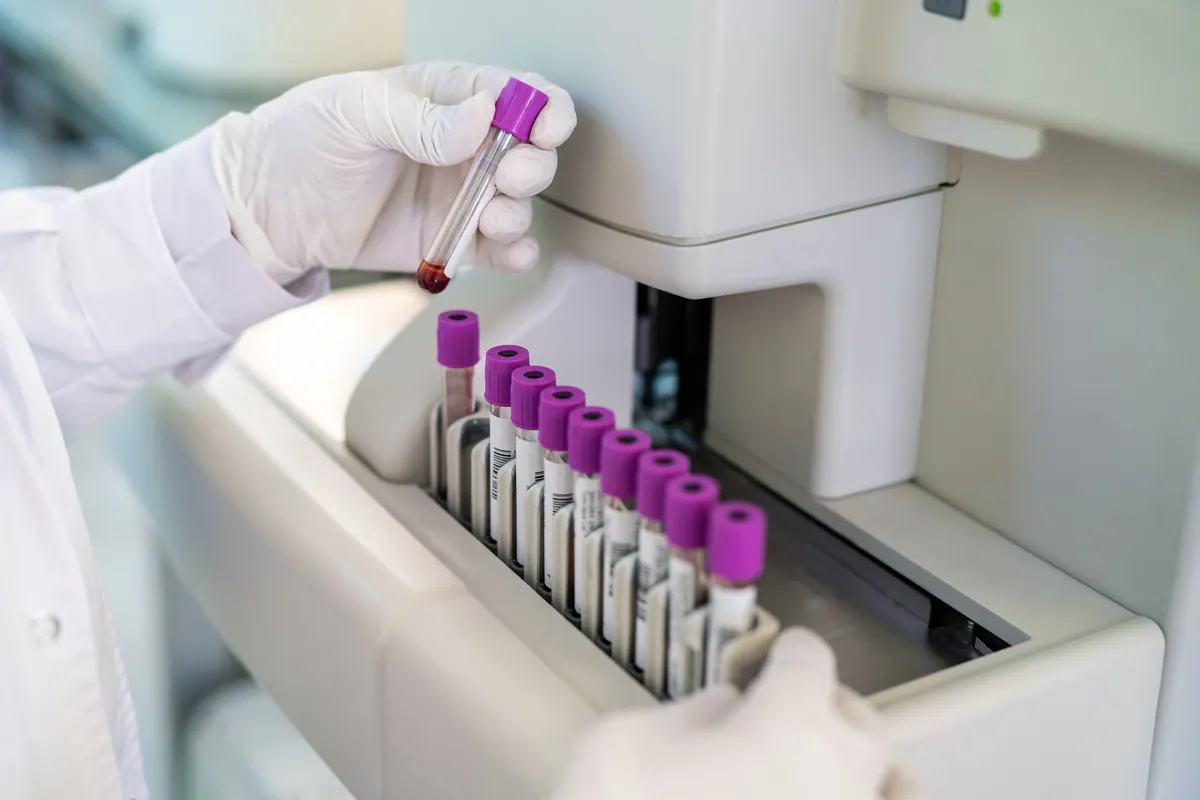
A blood sample is drawn from a vein, separated into serum and run on assays with established quality control and lab-specific reference ranges. That is what lets a TSH, an FSH or a total testosterone result be compared with a published range and repeated reliably over time.
Blood testing still has limits, and the major societies say so. The Endocrine Society’s position statement notes that blood hormone levels are difficult to regulate accurately because of normal physiologic and pharmacokinetic variation and the limitations of readily available assay methods. The Menopause Society’s 2022 statement goes further for women on treatment: serum hormone testing is rarely needed to manage menopausal hormone therapy. A blood test is the right tool for diagnosis and for specific questions, not for chasing a number every few weeks.
What do medical societies say about saliva testing?
They say it should not be used to set doses of estrogen, progesterone or testosterone. The Menopause Society’s key point is direct: it rates saliva and urine measurements as unreliable for working out a dose and advises against using them. It explains why, citing differences in hormone pharmacokinetics and absorption, daily (diurnal) variation, and variability both between women and within the same woman over time.
The Endocrine Society notes that supporters of custom-compounded hormone therapy assert that simple saliva tests can provide the information needed to customize doses, and that these claims are not supported by scientific data on assay quality control, standardization or clinical correlation. ACOG’s 2023 clinical consensus, reaffirmed in 2026, adds that compounded bioidentical menopausal hormone therapy is not a routine choice where an FDA-approved product is available, and that clinicians should counsel patients toward the approved options for menopausal symptoms.
Where does saliva testing hold up?
For cortisol, it holds up well. MedlinePlus explains that some cortisol passes into saliva and urine, and that measuring cortisol in these fluids is an accurate way to estimate blood cortisol. Because cortisol rises and falls through the day, a provider may ask for several saliva samples collected at home at different times, including late at night, to see when levels peak.
That use is specific: it helps diagnose disorders of too much cortisol, such as Cushing syndrome, when a clinician suspects one. It is not the same as a mail-order “adrenal” saliva panel interpreted against a generic curve.
What about urine and dried urine panels?
Urine testing has real but narrow clinical uses. MedlinePlus describes estrogen testing in blood, urine or saliva, including a 24-hour urine collection that a provider orders with detailed instructions on collecting and refrigerating every sample. The same page notes that saliva is usually the sample in at-home estrogen kits and suggests asking your provider which test to use.
Dried urine panels, which measure many hormone breakdown products from a few strips collected at home, are a different matter. The Menopause Society’s conclusion that urine testing to set doses is unreliable applies to them, and we found no society guideline that recommends them for diagnosing perimenopause or managing hormone therapy. They can produce detailed-looking reports, but a long report is not the same as a validated one.
Are at-home and mail-in hormone kits reliable?
Some are FDA-reviewed, many are not, and even good ones depend on careful collection. The FDA explains that direct-to-consumer tests usually ask you to collect a specimen such as saliva or urine and mail it in, and that the agency generally does not review laboratory developed tests created and run in a single lab. It warns that if you do not follow the directions carefully the test may not work correctly, and advises against making health decisions without first discussing the result with a clinician.
Home menopause kits are a useful example. The FDA’s page on home urine FSH tests puts their accuracy for detecting FSH at about 9 in 10, but adds that they show only whether FSH is raised, not whether you are in menopause or perimenopause. Results can be thrown off by first-morning urine, a lot of water before testing, or recent use of contraceptives, hormone therapy or estrogen supplements. The agency adds a safety point: do not stop contraception based on one of these kits.
How can a clinician help you choose?
By matching the sample to the question. A clinician asks what decision the result will inform, picks the fewest tests that can inform it, and chooses blood for almost every sex-hormone or thyroid question. Saliva is reserved for a suspected cortisol disorder, usually with an endocrinology team, and urine for specific collections or a home FSH strip that has started a conversation.
Our preventative labs for women use blood draws for every marker on the panel, from estradiol, progesterone, FSH, testosterone and SHBG to thyroid, iron, metabolic and heart tests, with same-day collection and results in 24 to 48 hours. If you have saliva or urine results from elsewhere, bring them; the provider will explain what they can and cannot tell you. For help deciding which markers matter for your symptoms, see our guide to hormone blood tests for women, and if price is part of the decision, our page on what hormone blood tests cost breaks down the drivers.
The online assessment is a good first step if you are not sure what to test. After the free ten-minute call, the visit happens in person or by video, and its purpose is to evaluate what you bring and lay out choices, not to promise a treatment. Book a consultation or compare other options on the compare hub.
