Answer · Pelvic floor
Does Emsella Work? What Studies Show for Bladder Leaks
Short answer
Emsella can reduce bladder leaks for some women, but the evidence is early. Uncontrolled studies of six 28-minute sessions reported fewer leaks and fewer pads for up to three months, and a 2025 meta-analysis found benefit but flagged heterogeneity and possible bias. Large sham-controlled trials and long-term results are still missing, so it is most sensibly used as an add-on to pelvic floor training.
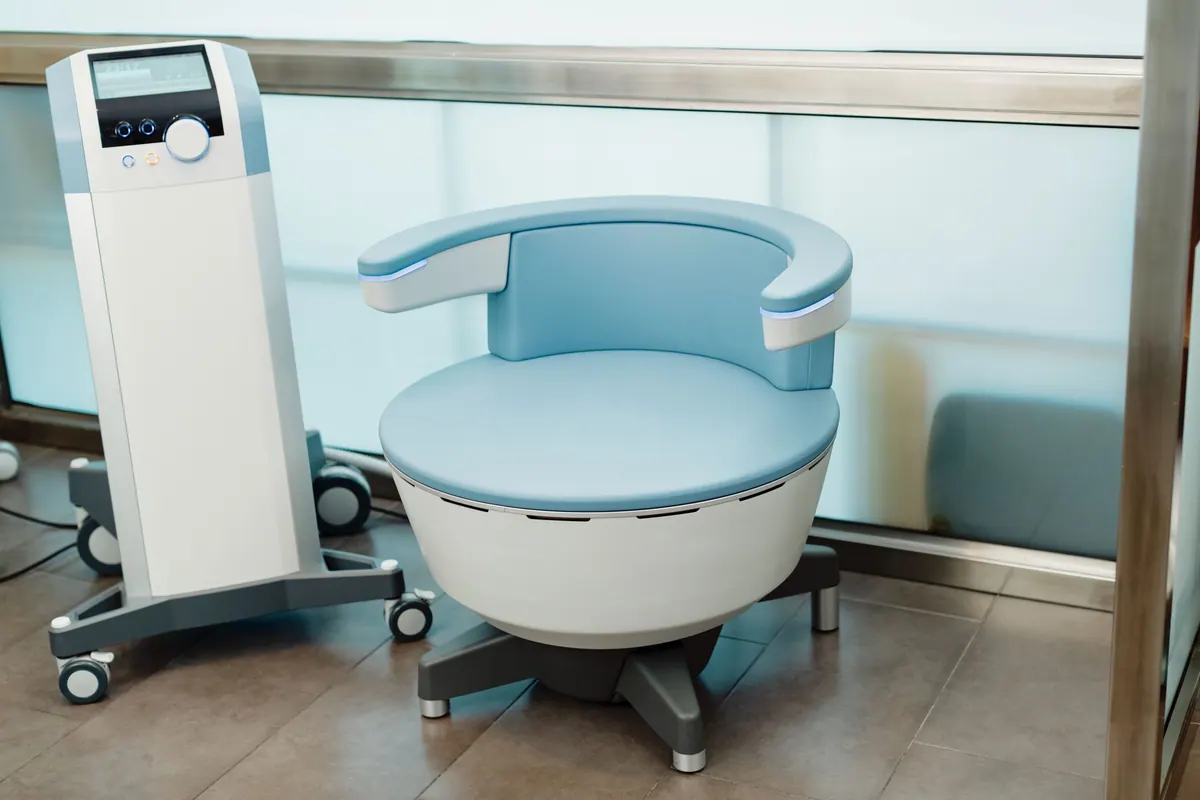
Does Emsella work? The honest short answer
For many women with stress or mixed leaks, Emsella appears to reduce how often they leak and how many pads they use, at least in the months after a course. The studies behind that statement are small, mostly without a comparison group, and short. So the fair answer is “it may help, and we cannot yet say how much of the effect is the chair itself or how long it lasts”.
That uncertainty does not make it useless. It makes it a reasonable option for women who want a noninvasive, fully clothed treatment, who cannot contract their pelvic floor well on their own, or who have trained without enough change, as long as expectations match the data.
What does the FDA clearance actually say?
The chair is a medical device, and devices reach the market differently from drugs. The HPM-6000UF, the system behind the EmSella chair, received 510(k) clearance on 14 November 2018. Its stated intended use is “entirely non-invasive electromagnetic stimulation of pelvic floor musculature for the purpose of rehabilitation of weak pelvic muscles and restoration of neuromuscular control for the treatment of male and female urinary incontinence”.
A 510(k) clearance means the FDA judged the device substantially equivalent to devices already on the market; here, the predicates were an earlier version of the same chair and an electrical stimulation and biofeedback device. The clearance summary describes the chair as “identical in design” to its predecessor and reports a male thermal-safety study, not an efficacy trial in women. Clearance tells you the device may be sold for incontinence. It does not tell you how well it works.
What did the main studies measure and find?
The 2019 multicenter Emsella study and the one pooled analysis give the clearest picture.
| Study | Design | Who | What was done | Main findings |
|---|---|---|---|---|
| Samuels and colleagues, 2019 | Open-label, single group, no sham | 75 women, average age 55, stress, urge or mixed leaks | Six 28-minute sessions, two per week; checked after session six and at 3 months | Leak questionnaire scores improved 49.93% after session six and 64.42% at 3 months; daily pads fell 43.80% and then 53.68%; no adverse events reported |
| Leonardo and colleagues, 2025 | Systematic review and meta-analysis | Seven studies of women with incontinence | Pooled HIFEM results against controls | Fewer leak episodes (mean difference minus 4.10) and better questionnaire scores; no significant difference in measured muscle contraction or resting tone; high heterogeneity and possible bias |
Two details matter when you read those numbers. First, the main outcome in the 2019 study was a questionnaire and pad count reported by the women themselves, with no group receiving a fake treatment for comparison; the authors list the lack of a sham group as a limitation. Second, the meta-analysis found symptom scores improved while objective muscle measures did not differ, which leaves open how the benefit happens.
Is there sham-controlled evidence at all?
There is some, but most of it comes from a different device. A randomized, double-blind, sham-controlled trial of 120 women with stress incontinence tested pulsed magnetic stimulation in 16 sessions over two months. At two months, 75% of the active group met the response target against 21.7% of the sham group. The trial protocol shows it used a different chair, the QRS-1010 PelviCenter, so the result supports magnetic pelvic floor stimulation as a concept rather than Emsella specifically.
A sham-controlled study of the Emsella chair itself is under way. Its ClinicalTrials.gov record describes a single-blind randomized comparison of the chair against sham for stress incontinence, started in December 2019, still recruiting as of its July 2026 update, with an estimated 110 participants and primary completion estimated for October 2028.
Where are the biggest gaps?
The open questions are about size, controls and time:
- Durability. Follow-up in the main Emsella study ended at three months. Whether results fade, and how often maintenance sessions are needed, has not been settled by trials.
- Placebo effect. Lying in a chair that produces strong contractions is a vivid experience, and without a sham arm, expectation can inflate self-reported results.
- Mechanism. If muscle strength and tone do not measurably change, part of the benefit may come from learning what a pelvic floor contraction feels like, which also helps exercise.
- Urgency. Magnetic stimulation for urge leaks has been tested in only a handful of small studies, according to a 2023 systematic review, so the chair is not a stand-alone urgency treatment.
- Comparison with training. Few studies compare the chair head to head with supervised pelvic floor muscle training, which has the stronger evidence base.
Who seems to respond, and who should look elsewhere?
In the 2019 study, women with mixed incontinence improved the most (69.90% on the questionnaire). Women who cannot find or squeeze their pelvic floor muscles are a logical group to try it, because the chair produces contractions they cannot make on demand. Leaks that began after a birth are a common reason to ask; our page on bladder leaks after childbirth covers what recovery usually looks like first.
It is not the right tool when the main problem is elsewhere. Large prolapse, a pelvic floor that is too tight rather than weak, infection, or a bladder that does not empty need their own evaluation. The 2019 study excluded women with metal implants, a recent operation or a pregnancy, and urgency linked to menopause-related tissue changes has other treatment options, explained in our page on how menopause affects bladder control. If you are unsure which picture fits, the symptom assessment can help you start, and you can compare this with other answers on bladder and pelvic health.
How Emsella is offered at our clinic
We use the chair as one part of a plan, not as a stand-alone promise. Before a course, a provider takes your history, examines your pelvic floor and tissue, checks a urine sample, and confirms there is no pacemaker, metal implant near the pelvis or pregnancy. A typical course is six 28-minute sessions over three weeks, fully clothed, with no downtime. Sessions take place in person at San Gabriel or Downey.
Alongside the chair, you are taught pelvic floor exercises properly, offered vaginal estrogen when post-menopausal tissue is thin, and referred to pelvic floor physical therapy when hands-on work would serve you better. We tell you plainly what the studies do and do not show, and we review your progress after the course. Details are on the pelvic floor treatment page.
Use the free ten-minute phone call to ask whether a consultation makes sense; a provider decides with you, after examining you, whether the chair fits. Book a consultation when you are ready.
